GIANT FOAMBOARD AIRCRAFT PROJECT

GFA Mk. III

Conception

With the onset of a new year and changing teams, GFA as a society set its sights to define design and manufacturing standards which can be adopted and developed through the coming years. This gave rise to GFA MK-III, an ambitious project which aimed to develop a conventional aircraft with the largest wingspan yet.
Requirements
The requirements for GFA MK-III stemmed from three distinct aims – design of a new and untested aircraft configuration, defining exemplary manufacturing techniques, and well-documented report describing the design, manufacturing, and field testing. The Open License Category defined by CAA restricted the aircraft all-up mass to 25 kg, and the available material for the mainframe was White Foamboard. The aircraft also had to be designed for a quick and easy assembly process to enable rapid flight testing and changes.

Conceptual Design
The aircraft was sized using performance parameters, having a short takeoff distance, low cruise speed, and high climb angle. Additionally, the wings were set to a wingspan of 7 m, and the physical parameters sized accordingly. The flight envelope covered manoeuvres from -1 G to 2 G, and a 50 % safety factor was given to MK-III for a strong design.

Final Design

The final design consisted good practices from previous years, newly developed manufacturing methods, and fresh takes on mechanical assemblies. The wing had an internally tapering spar to keep it lightweight with a single internal connector to join both wings. The tails assembled into a single assembly. Both wings and tails were easily slotted from the top. Additionally, the landing gear was changed to a carbon fibre and 3D printed assembly with solid rubber tyres for a higher durability, and every bolt had an access hatch for installation and end-of-life disassembly.
Mass breakdown
49 % of the aircraft all-up mass consists of foamboard, while the glue only accounts for12 %. This denotes a significant improvement since the start of GFA aircraft series, which had roughly 35 % foamboard and 20 % glue. Approximately 20 % of the aircraft mass consists of avionics and mechanical jointers, which indicates that just the mainframe of the aircraft consists of even higher fraction of foamboard. The mass breakdown gives a reasonable estimate for mainframe distribution for most lightweight UAVs made from depron foam.

Flight Testing
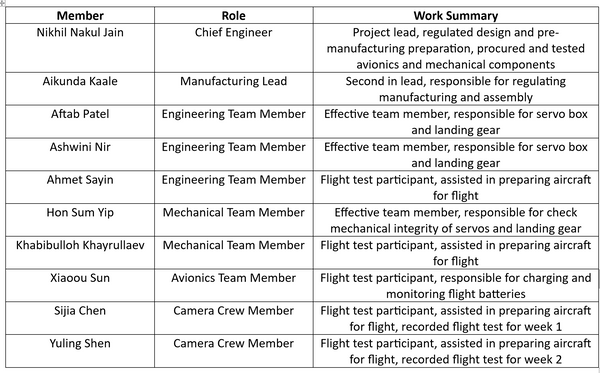
Flight test preparations revealed multiple points of improvement, including critical and unnecessary areas of glue, better wing connector design, and insight into smaller manufacturing practices and systems setup. The aircraft saw multiple tests, which included servo durability checks, thrust tests, and taxi tests, and nose steering tests. GFA MK-III carried out two flights – 7.5 minutes and 2.5 minutes long, giving a total flight time of 10 minutes over two flights. This sets the single longest flight time, and the cumulative longest flight time of any GFA aircraft manufactured by the society.


The Team



Successful first flight